
Study Links Early Universe Little Red Dots to Spiral Galaxies
New research published on July 29 reveals that enigmatic little red dots in the early universe may be distorted by an observational bias. The findings suggest these distant sources ultimately evolve into lower-redshift spiral galaxies like the Saguaro.
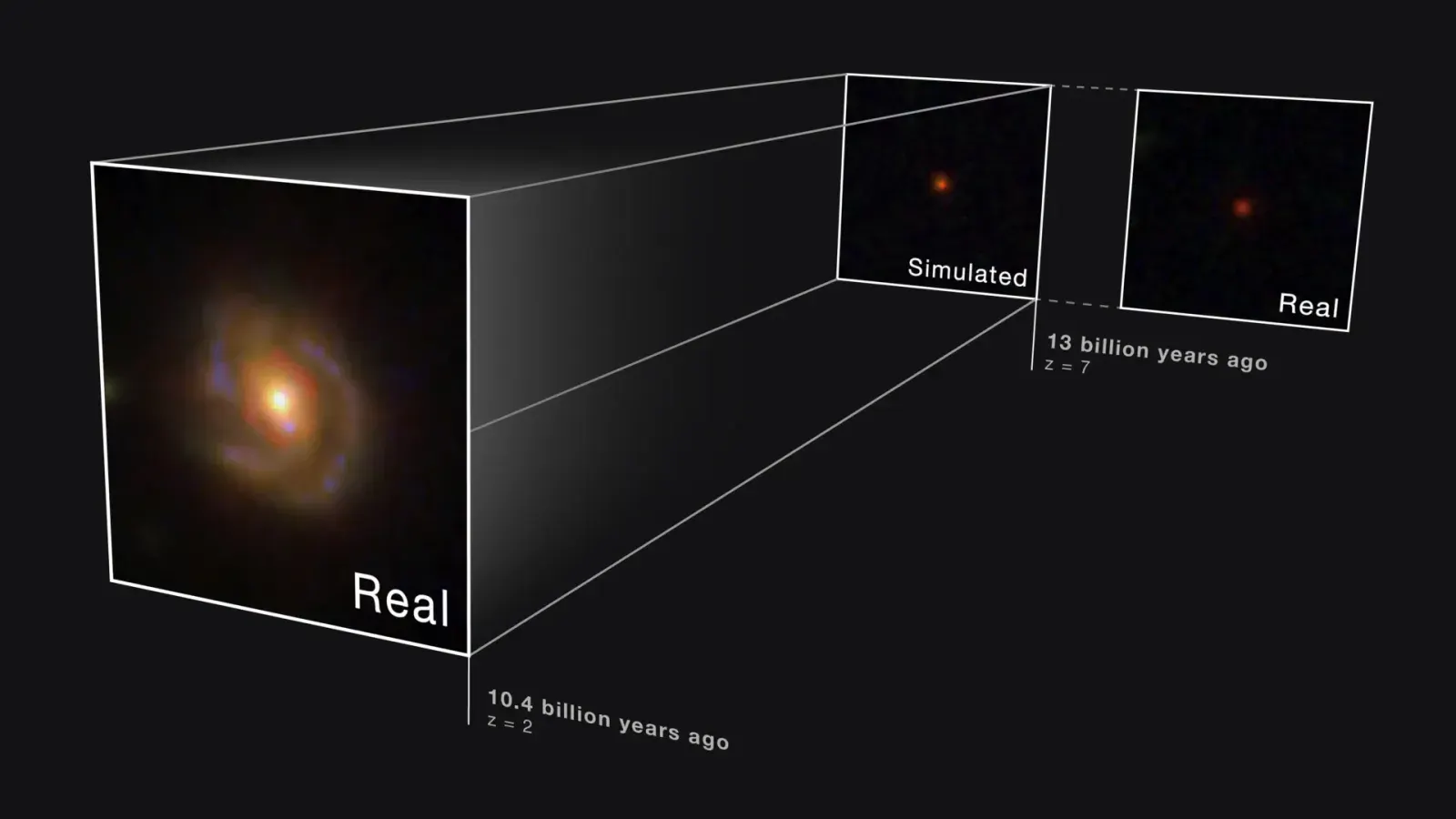
A new study published on July 29 in The Astrophysical Journal sheds fresh light on the nature of little red dots, or LRDs, discovered in the early universe. According to the research, these mysterious objects may be significantly affected by an observational bias. At extreme distances, surrounding galactic structures become too faint to be detected by current instruments, leaving only the exceptionally bright central source visible to astronomers.
To investigate this phenomenon, an international team of researchers—including Pierluigi Rinaldi, George Rieke, Fabio Pacucci, Zihao Wu, and Carys Gilbert—focused their attention on a lower-redshift spiral galaxy named the Saguaro, formally cataloged as WISEA J123635.56+621424.2 and located at redshift 2. The Saguaro features a distinctive, compact red center that bears a striking physical resemblance to a little red dot, while simultaneously offering a much closer laboratory for detailed astrophysical observation.
When the scientific team conducted computer simulations of the Saguaro placed at a much higher redshift, the results were striking. The modeling demonstrated that the galaxy's intricate surrounding spiral structure would completely fade from view, effectively leaving behind only the isolated, LRD-like center that has puzzled astronomers since its initial detection in deep-space surveys.
Further observations bolster the connection between these celestial objects. NASA's Chandra X-ray Observatory successfully detected weak X-ray emission emanating from the Saguaro. According to researcher Carys Gilbert, the X-ray light observations demonstrate that this specific galaxy houses an active galactic nucleus, and a heavily obscured one at that, providing crucial clues about the internal power sources driving these galactic systems.
The implications of this research extend far into our understanding of cosmic evolution. George Rieke of the University of Arizona's Steward Observatory noted that everything created in the early universe must eventually evolve into something residing in our current cosmic neighborhood. While researchers previously had little idea of what LRDs ultimately become, Rieke emphasized that these new findings finally point the way toward identifying their modern-day progeny.
Elaborating on the significance of the target, Fabio Pacucci highlighted that the Saguaro serves as a prototypical little red dot and stands as one of the few examples discovered at a lower redshift. This proximity allows scientists to trace the evolutionary pathway of these dots across vast stretches of cosmic time. Zihao Wu added that because the Saguaro resides at a lower redshift, researchers can examine its beautiful and bright host galaxy in exceptionally high resolution and detail using both the James Webb Space Telescope and the Hubble Space Telescope.