
Bangladesh Islami Chhatra Shibir Details Enforced Disappearances
Bangladesh Islami Chhatra Shibir has held a press conference at the University of Dhaka regarding enforced disappearances over the past fifteen years. The organization detailed statistics on missing members and called for effective reforms and justice.
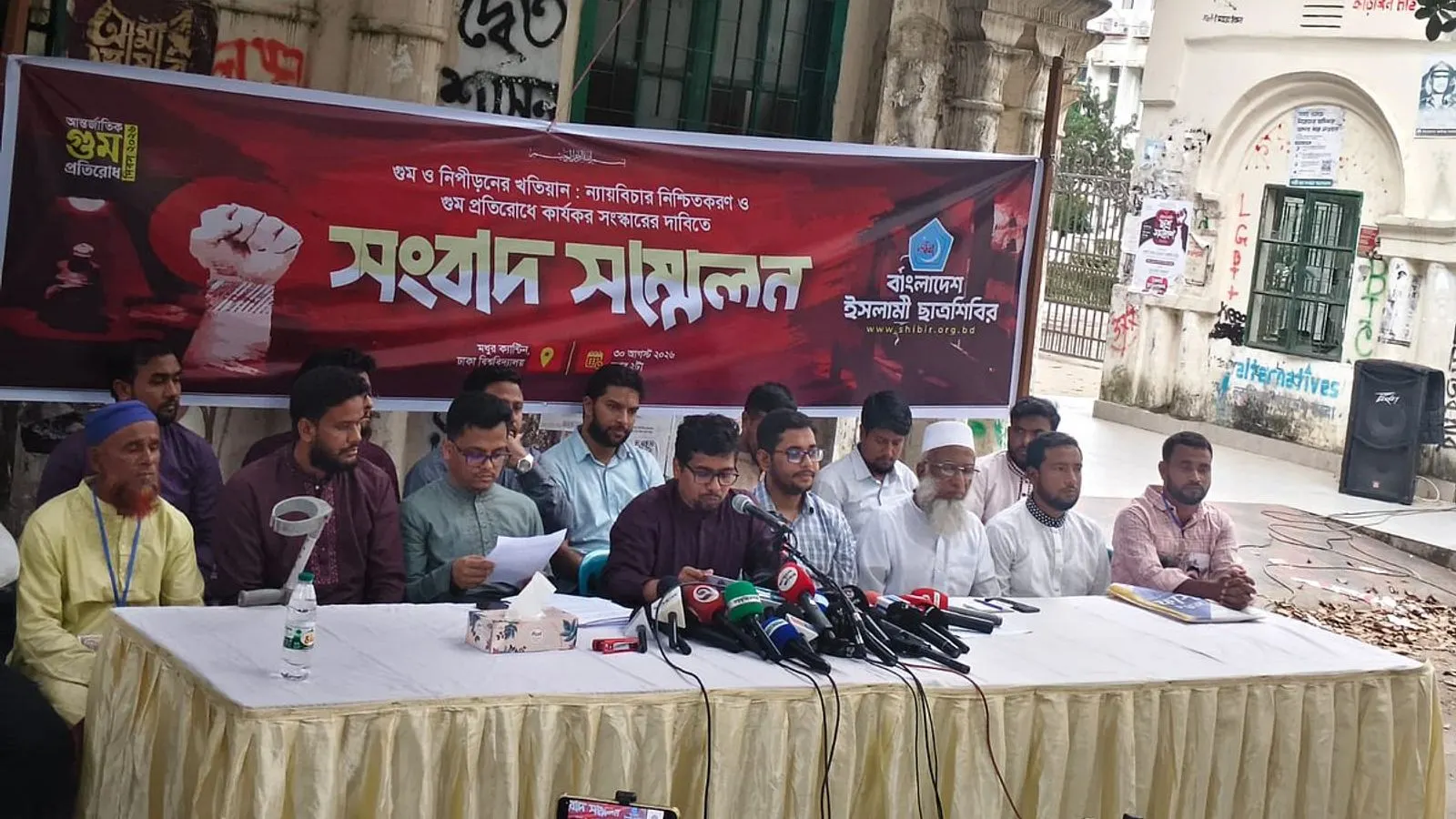
On August 30, 2026, Bangladesh Islami Chhatra Shibir hosted a press conference at Madhur Canteen, located within the University of Dhaka. The briefing was titled 'Account of Enforced Disappearances and Oppression: Demand for Ensuring Justice and Effective Reforms to Prevent Disappearances'. During the event, leaders addressed the historical context of enforced disappearances affecting their organization and presented documented figures concerning the missing individuals.
According to the organization's official claims presented at the press conference, a total of 236 leaders and activists of Bangladesh Islami Chhatra Shibir have fallen victim to enforced disappearances over the past 15 years. The speakers further elaborated that when accounting for individuals who have not formally lodged complaints, the actual number of disappeared persons is projected to surpass 700. Within the broader demographic of politically affiliated victims, members of the student organization account for 25.42 percent.
The discussion also highlighted broader national data regarding the phenomenon. Findings from the final report of the Commission of Inquiry on Enforced Disappearances indicate that, following a thorough verification process, evidence has been established in 1,569 distinct incidents of enforced disappearances. Despite these widespread investigations, the organization reported that seven of its specific leaders and activists remain missing to this day.
During the proceedings, Maulana Abdul Halim shared a poignant personal account regarding his missing son, Al-Moaddas, who disappeared on the night of February 4, 2012. He stated that for 14 long years, he has searched various locations for his son, including visiting different camps operated by the Rapid Action Battalion (RAB) and filing a writ petition with the High Court. He noted that although he harbored hopes for justice following the events of August 5, those expectations have yet to be fulfilled.
The press conference underscored ongoing demands for accountability from state and security institutions, referencing entities such as the Detective Branch (DB), the Directorate General of Forces Intelligence (DGFI), the Rapid Action Battalion (RAB), and the Counter Terrorism and Transnational Crime (CTTC) unit. Leaders emphasized the necessity of structural reforms and transparent legal proceedings through mechanisms such as the International Crimes Tribunal to address historical grievances and prevent future violations.