
The Decay of Ruplal House: A History of Old Dhaka's Landmark
Ruplal House in Old Dhaka boasts a rich history spanning Armenian landowners, British architects, and grand royal receptions. Today, despite being listed as a protected antiquity, the historic mansion faces severe neglect and dilapidation.
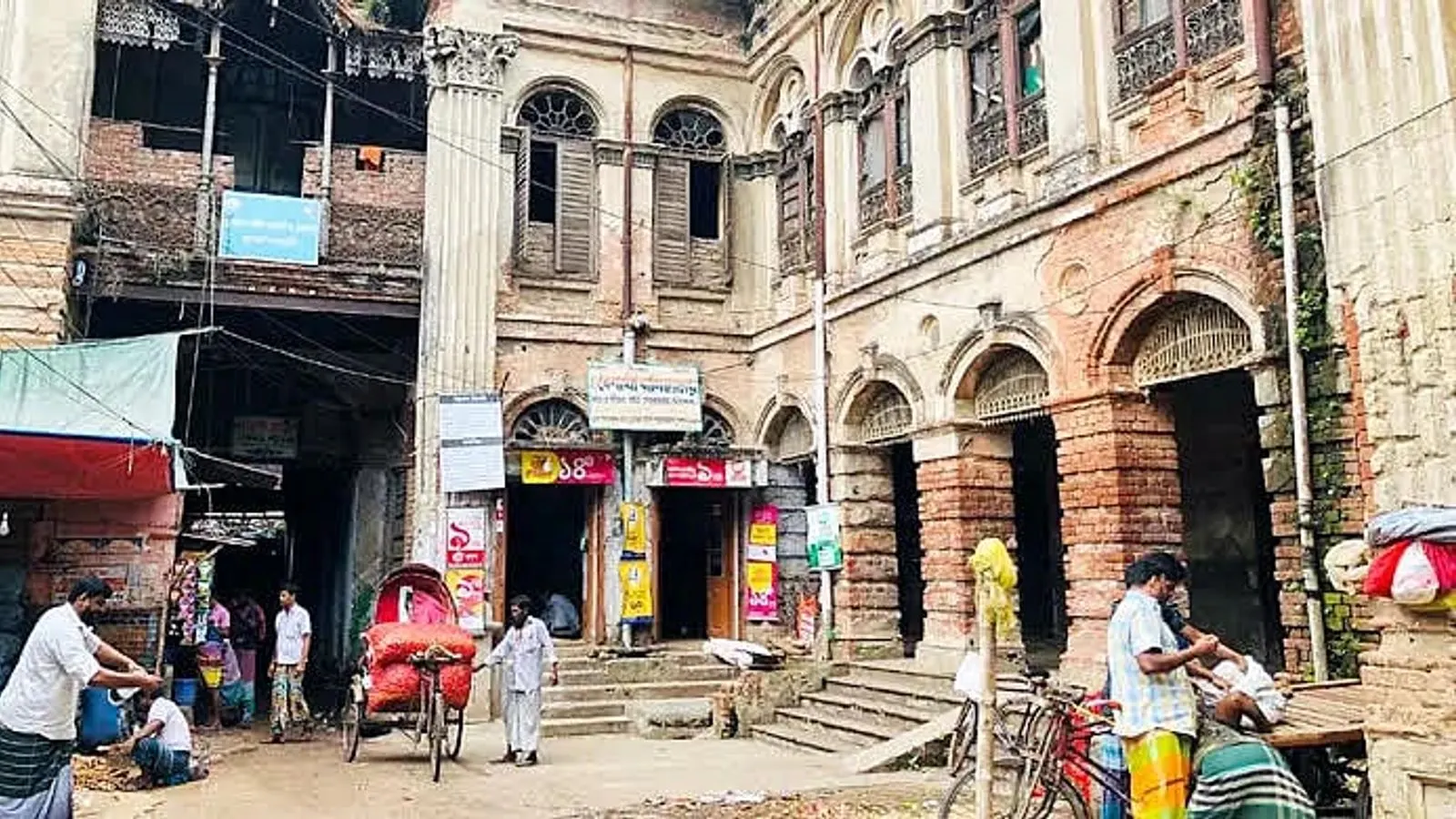
Ruplal House stands as a monumental historical and architectural landmark situated in the Farashganj and Shyambazar areas of Old Dhaka. The origins of this grand estate trace back to around 1825, when an Armenian landowner named Aratun constructed an initial two-storey building on the property. This foundational structure later underwent a dramatic transformation when it was purchased around 1835 by the prominent businessman Ruplal Das, alongside his relative Raghunath Das, giving the estate the name by which it is widely recognized today.
As the wealth and influence of the Das family grew, they sought to match their status with a residence of matching grandeur. They commissioned Martin and Co., a famous British engineering company based in Kolkata, to completely rebuild the structure. The resulting architectural marvel stretched to approximately 91.44 meters in length and featured more than 50 distinct rooms. The sheer scale and opulence of the newly reconstructed mansion quickly established it as one of the premier private properties in the region during the colonial era.
The estate soon became a central hub for elite social gatherings and high-society events in Dhaka. A notable historical highlight occurred in 1888 when the Viceroy of India, Lord Dufferin, visited Dhaka and was honored with a lavish dance party hosted inside the magnificent halls of Ruplal House. However, the grand mansion also weathered significant natural disasters over the decades. A devastating earthquake in 1897 struck the region, causing major structural damage that notably destroyed the clock on the building's peak, a feature that was never fully restored to its original glory.
Following changes in ownership and the shifting political and social landscapes of the region, the property changed hands in the mid-twentieth century. In 1958, a buyer named Mohammad Siddique Jamal purchased the sprawling historic residence and renamed it Jamal House. Over the subsequent decades, the building experienced further transitions and increasing neglect as urbanization transformed the surrounding neighborhoods of Old Dhaka, drawing concern from preservationists and historians alike regarding its structural integrity.
In the modern era, the historical significance of the landmark has been formally recognized by the government, placing the property under the official list of protected antiquities managed by the Department of Archaeology. Despite this protected status, the sprawling estate—complete with its massive footprint and dozens of rooms—currently remains in a heavily dilapidated state. Preservation advocates continue to monitor the structure as it stands as a fragile physical link to the nineteenth-century history of Dhaka.