
Severe Crises Disrupt Services at Jashore's Keshabpur Upazila Health Complex
Jashore's Keshabpur Upazila Health Complex is facing severe operational crises, including acute shortages of doctors, staff, medicines, and a broken X-ray machine. Patients are enduring immense suffering due to these prolonged shortages and lack of reliable ambulance services.
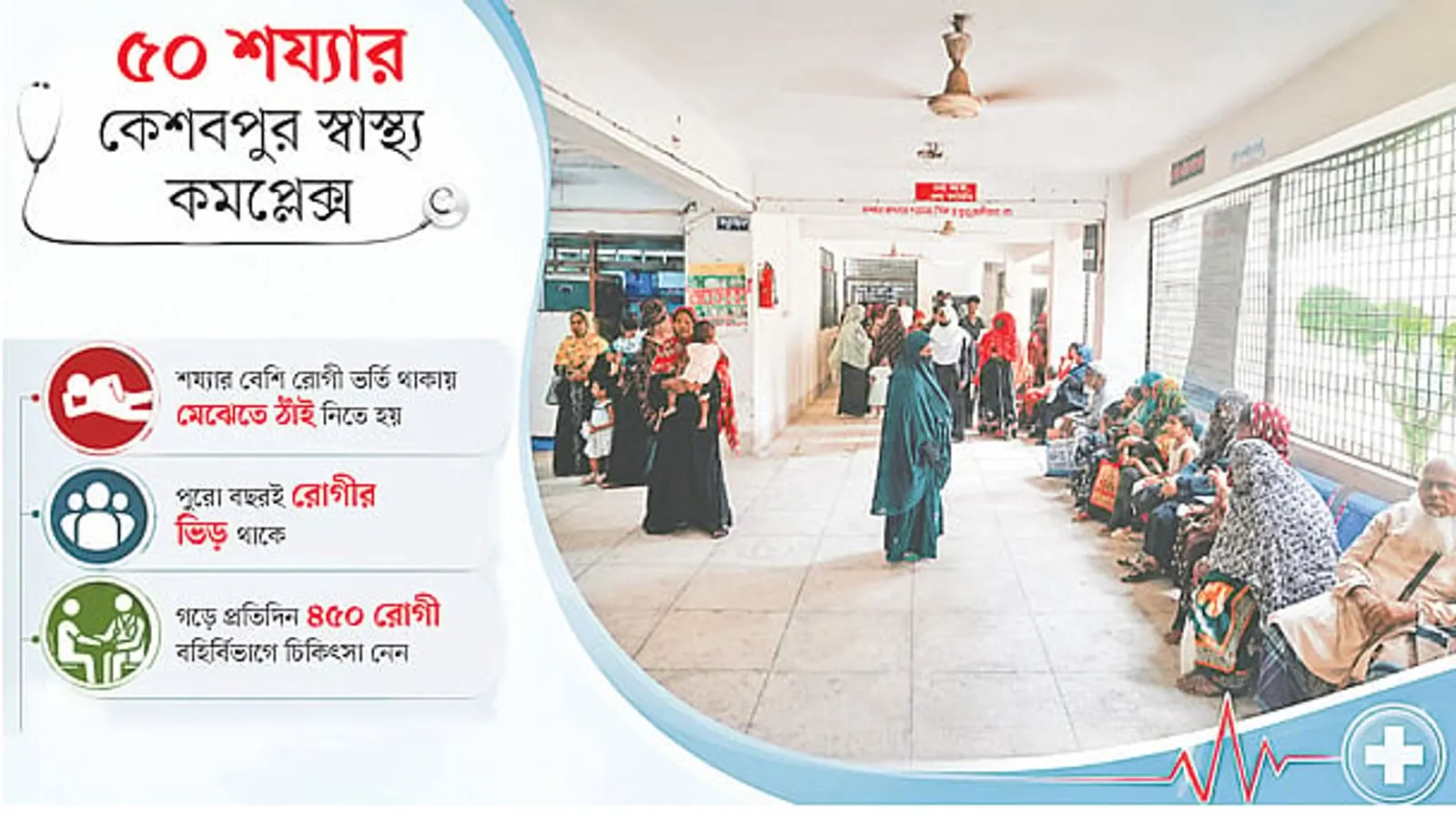
The Keshabpur Upazila Health Complex in Jashore is currently operating under deeply critical conditions, marked by severe shortages of medical professionals, essential medicines, and functional diagnostic equipment. According to official administrative data, the 50-bed health facility is officially authorized to have 43 physicians on its staff. However, the hospital currently functions with only 24 active doctors, leaving a staggering 19 physician positions completely vacant. This chronic understaffing severely impairs the daily delivery of medical care to the surrounding communities who rely entirely on this public institution for their basic healthcare needs.
In addition to the physician shortage, the health complex is grappling with severe deficits in support staff. Out of the designated 1,118 positions required for third-class employees, only 77 individuals are currently employed. Similarly, the fourth-class employee category is officially structured for 23 workers, but only 14 positions are filled. Furthermore, while the hospital requires five dedicated sanitation workers to maintain hygiene standards, only a single cleaner is currently available to manage the entire facility. Despite these compounding operational limitations, patient volume remains consistently high, with approximately 450 patients visiting the outpatient department daily, while the inpatient department regularly manages around 100 admitted patients at any given time.
Patient care is further compromised by a critical lack of essential pharmaceutical supplies and vital diagnostic tools within the complex. On August 24, 2024, institutional records and local reports highlighted that numerous patients are being deprived of basic government-provided medications. Voicing deep frustration over the situation, a service seeker named Urmi Khatun questioned the quality of healthcare administration by pointing out that patients cannot even obtain standard government-supplied drugs from such a large hospital. Echoing these concerns, another patient, 70-year-old Abdul Khaleq, revealed that the facility's primary X-ray machine has remained completely out of order for two consecutive years. Consequently, Khaleq was forced to spend 450 Taka at an external private facility to complete an X-ray, whereas undergoing the same diagnostic procedure inside the hospital would have cost only 220 Taka.
Transportation logistics present yet another major hurdle for patients requiring emergency transfers to advanced medical facilities. The health complex has been operating without a dedicated ambulance driver for four full years, rendering the official vehicle practically unusable under normal scheduling. Khalidur Rahman, whose relative needed emergency transport, stated that while the official government ambulance fee to travel to Khulna is officially set at 1,020 Taka, they were forced to pay double that amount—totaling 2,200 Taka—to arrange alternative transport to Khulna because the hospital vehicle could not be dispatched.
Hospital authorities have acknowledged the profound depth of these administrative and operational challenges while pointing toward ongoing bureaucratic processes for potential remedies. Md. Rehenewaz explained that the ongoing absence of a regular driver prevents the ambulance service from functioning properly, noting that he occasionally has to utilize his own vehicle's driver to assist stranded patients in urgent situations. Rehenewaz also confirmed that the breakdown of the X-ray machine has been formally reported to the Ministry of Health for the past two years, and added that because the previous fiscal year has concluded, many routine medicines have run out, though fresh supplies are expected once new procurement procedures are finalized. Expanding on the administrative response, Md. Masud Rana stated that the ambulance crisis cannot be resolved until a permanent driver is officially appointed. Rana also assured that once the ongoing tender processes for medicine procurement are successfully concluded, the current drug shortages will significantly ease, while the procurement of a brand-new X-ray machine remains actively under consideration.
Local civil society representatives and community members have expressed deep alarm regarding the deteriorating state of public health delivery at the institution. Abubokkar Siddiqui, a prominent figure within the Keshabpur Nagorik Samaj, emphasized that the multifaceted crises are inflicting extreme suffering on vulnerable patients who seek medical attention at the facility. Siddiqui has urgently demanded that the relevant authorities promptly address and resolve these systemic problems to restore a proper standard of healthcare services for the local population.