

Researchers Uncover Major Thermal Anomaly Deep Inside Mars
A new study reveals a significant temperature imbalance within Mars, with the southern interior measuring hundreds of degrees warmer than the north. Published on August 27 in Nature, the research utilized data from multiple spacecraft to examine the planet's internal structure.
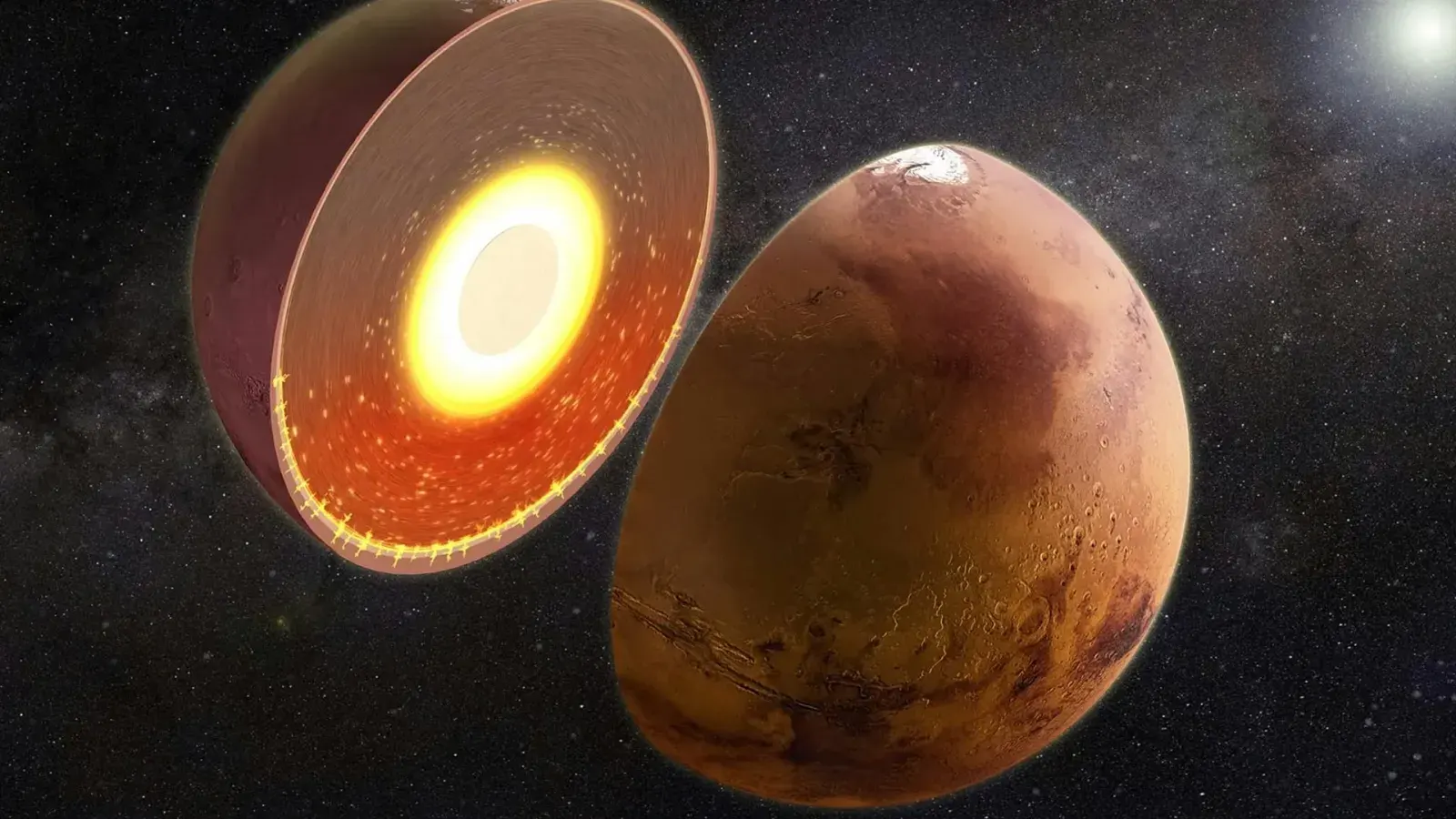
Researchers have uncovered a major temperature imbalance and thermal anomaly deep inside Mars, revealing that the planet's interior is far more complex than previously understood. According to a study published on August 27 in the journal Nature, scientists found that the southern interior of Mars is about 200 to 400 degrees Celsius warmer than the northern region.
The international research effort was led by Alexander Berne. Other researchers involved in the study include Amirhossein Bagheri, Nicholas Wagner, Harriet Lau, Isamu Matsuyama, Angela Marusiak, Sander Goossens, Karwai Cheng, Antonio Genova, Marc Rovira-Navarro, Chuan Qin, Douglas Hemingway, Shijie Zhong, and Francis Nimmo. The work also drew upon contributions from institutions such as Caltech, the University of Arizona, Brown University, the NASA Goddard Space Flight Center, the Institute of Astronomy and Astrophysics at Academia Sinica, the University of Rome, Delft University of Technology, UCLA, the University of Texas at Austin, the University of Colorado Boulder, and UC Santa Cruz.
To uncover these hidden thermal details, the research team utilized gravity data collected from past orbital missions, specifically the Mars Global Surveyor, Mars Odyssey, and the Mars Reconnaissance Orbiter operated by NASA. Commenting on the traditional views of planetary interiors, lead author Alexander Berne stated: "Scientists usually assume that the interiors of planetary bodies are generally spherically symmetric, but this is not necessarily true."
Elaborating on the significance of mapping planetary interiors using this approach, Berne explained: "As we get more gravity data, we can determine the three-dimensional intricacies of a planet's interior structure. These inferences in turn give us a blueprint for designing future missions and scientific exploration of these worlds. Understanding the interior structure of planetary bodies helps us unravel the processes that shaped their formation and evolution."
In the course of their investigation, the researchers considered several distinct hypotheses to explain the observed thermal anomaly beneath the Martian surface. The hypotheses evaluated by the team included a giant impact that could have released heat from the northern hemisphere, spontaneous convection occurring within the southern mantle, or thick geological structures that successfully trapped heat in the south.
Discussing the broader implications of these findings regarding the planet's history and potential habitability, Amirhossein Bagheri noted: "The dichotomy that we see between north and south is important to understand because it gives information about processes that may have influenced the hydrology of Mars, including the formation of basins that may have held water."