
Martha Nussbaum Inaugurates Reading Circle Hosted by Banglar Pathsala
US philosopher Martha Nussbaum delivered the keynote address at a newly inaugurated reading circle event organized by Banglar Pathsala. The virtual or in-person gathering featured prominent intellectuals including economist Rehman Sobhan and Dhaka University professor A I Mahbubuddin Ahmed, with session moderation by founder Ahmed Javed.
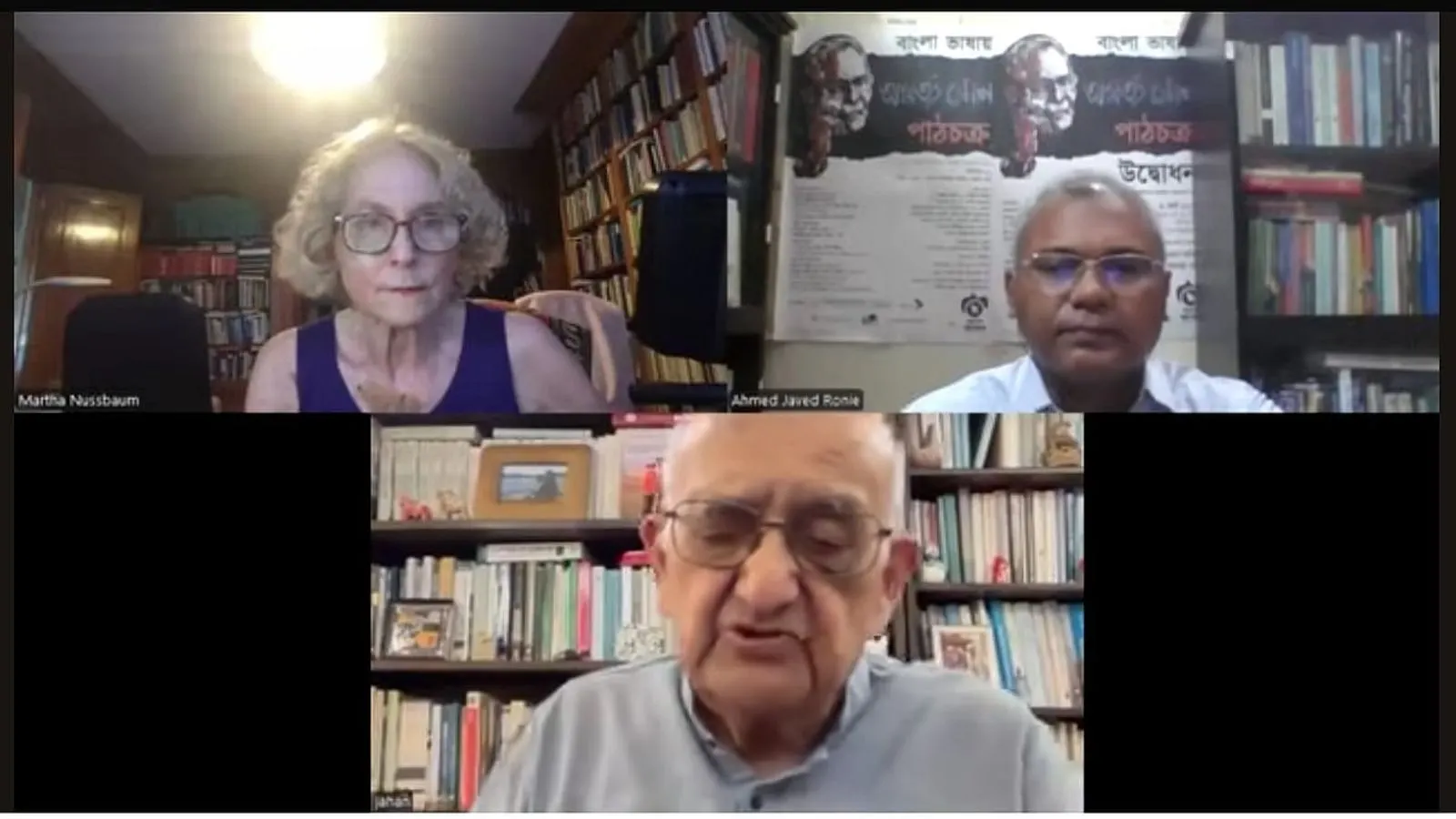
US philosopher Martha Nussbaum recently delivered the keynote address at the opening ceremony of a newly inaugurated reading circle. The event was organized by Banglar Pathsala, an organization that brought together notable scholars, thinkers, and academics for the special inaugural occasion held on a Friday night.
During the inaugural event, the discussions heavily centered around intellectual frameworks and philosophical inquiries. Prominent figures participating in the scholarly dialogue included renowned economist Rehman Sobhan and A I Mahbubuddin Ahmed, a teacher from the Department of Sociology at the University of Dhaka. Their presence added significant academic depth to the opening proceedings of the reading circle.
The entire opening ceremony and discussion session was smoothly conducted under the guidance of the event's moderator. Ahmed Javed, who serves as the founder of Banglar Pathsala, took on the role of hosting and orchestrating the proceedings for the evening, ensuring that the dialogue between the distinguished participants remained engaging and focused.
A major focal point of the opening session was the presentation and discussion of Martha Nussbaum's notable work. During her keynote delivery, the American philosopher prominently referenced her book titled 'Justice for Animals: Extending the Capability Approach to Non-Human Beings', establishing the core theme of the academic discourse.
Elaborating on the philosophical concepts within her work, Nussbaum shared profound insights regarding the relationship between different living entities. She explicitly noted that human and animal capabilities are not isolated from one another, but rather that these capabilities can advance alongside each other, expanding the traditional boundaries of capability theory.