Dhaka marks Eid-e-Miladunnabi 1448 Hijri at Baitul Mukarram
The inauguration ceremony for the celebration of Eid-e-Miladunnabi (SAW) 1448 Hijri was held on 25 August at the Baitul Mukarram National Mosque in Dhaka. The joint event, organized by the Ministry of Religious Affairs and the Islamic Foundation, featured prominent addresses focusing on religious harmony, state welfare, and Prophet Muhammad's enduring teachings.
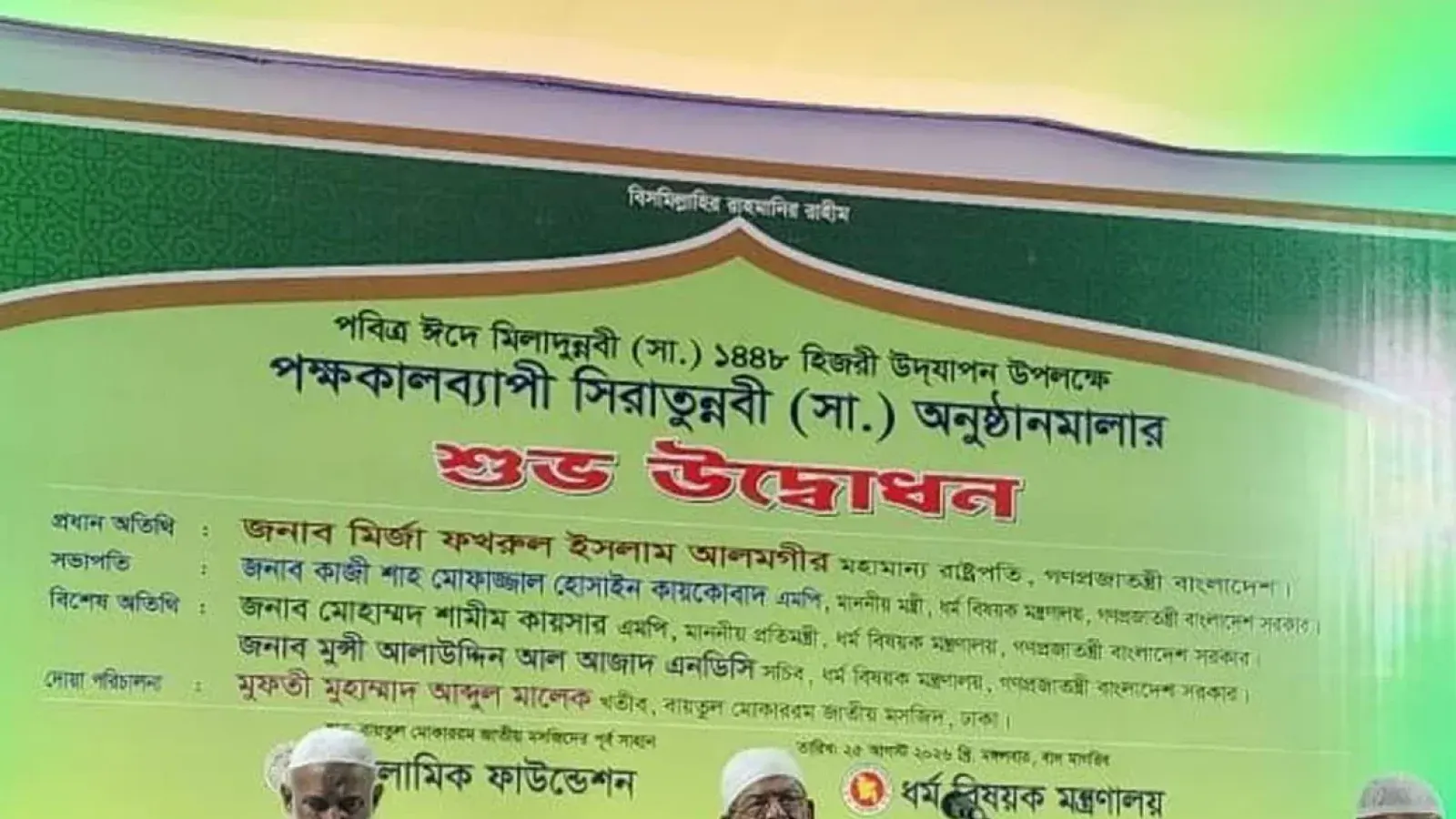
On 25 August, the official inauguration ceremony for the celebration of Eid-e-Miladunnabi (SAW) 1448 Hijri took place at the historic Baitul Mukarram National Mosque located in Dhaka. The significant national event was jointly organized by the Ministry of Religious Affairs and the Islamic Foundation to observe the auspicious occasion with due religious fervor and institutional participation.
The high-profile gathering was presided over by the Minister for Religious Affairs, Kazi Shah Mofazzal Hossain Kaykobad, who oversaw the proceedings alongside other notable figures including Mohammad Shamim Kaiser, Munshi Alauddin Al Azad, and Mufti Muhammad Abdul Malek. The inauguration also drew focus to foundational national leaders and figures such as Ziaur Rahman and Khaleda Zia during the broader observance context.
Serving as the chief guest at the inauguration ceremony, Mirza Fakhrul Islam Alamgir delivered a comprehensive address detailing the government's ongoing commitments to religious leaders and institutions. He stated that the current administration remains fully committed to enhancing the dignity and ensuring the overall welfare of religious leaders across the country, highlighting that monthly honorarium allowances have already begun for imams, muezzins, and khadims.
Expanding on the financial welfare initiatives for places of worship, Mirza Fakhrul Islam Alamgir made a key statistical commitment during the event. He announced that before the year 2030, in accordance with official promises, all mosques and other religious places of worship throughout the country will be brought under the coverage of monthly honorarium allowances, noting that the work to provide similar honorariums to service providers in other religious worship places has already commenced.
Turning to the spiritual and historical significance of the occasion, the chief guest emphasized the universal applicability of Islamic teachings in contemporary society. He stated that the historic Farewell Pilgrimage (Hajj) speech delivered by the Prophet Muhammad (SAW) remains profoundly relevant for the entire human race today, embodying lessons of human dignity, equality, brotherhood, justice, and mutual rights.
Concluding his extensive remarks on the Prophet's character and societal framework, Mirza Fakhrul Islam Alamgir stressed that to overcome the modern spread of violence, conflict, intolerance, discrimination, extremism, falsehood, and moral degradation, following the ideals of the Prophet (SAW) has no alternative. He further noted that the Prophet's exemplary life integrated truthfulness, justice, forgiveness, tolerance, humanity, and profound compassion, especially toward the poor, orphans, helpless, and oppressed.