Jefferson Lab Researchers Identify Two Unexpected Subatomic Structures
Physicists working at the Thomas Jefferson National Accelerator Facility have identified evidence for two unexpected structures related to XYZ states. The discovery was made by the Gluonic Excitations Collaboration using experimental facilities in the United States.
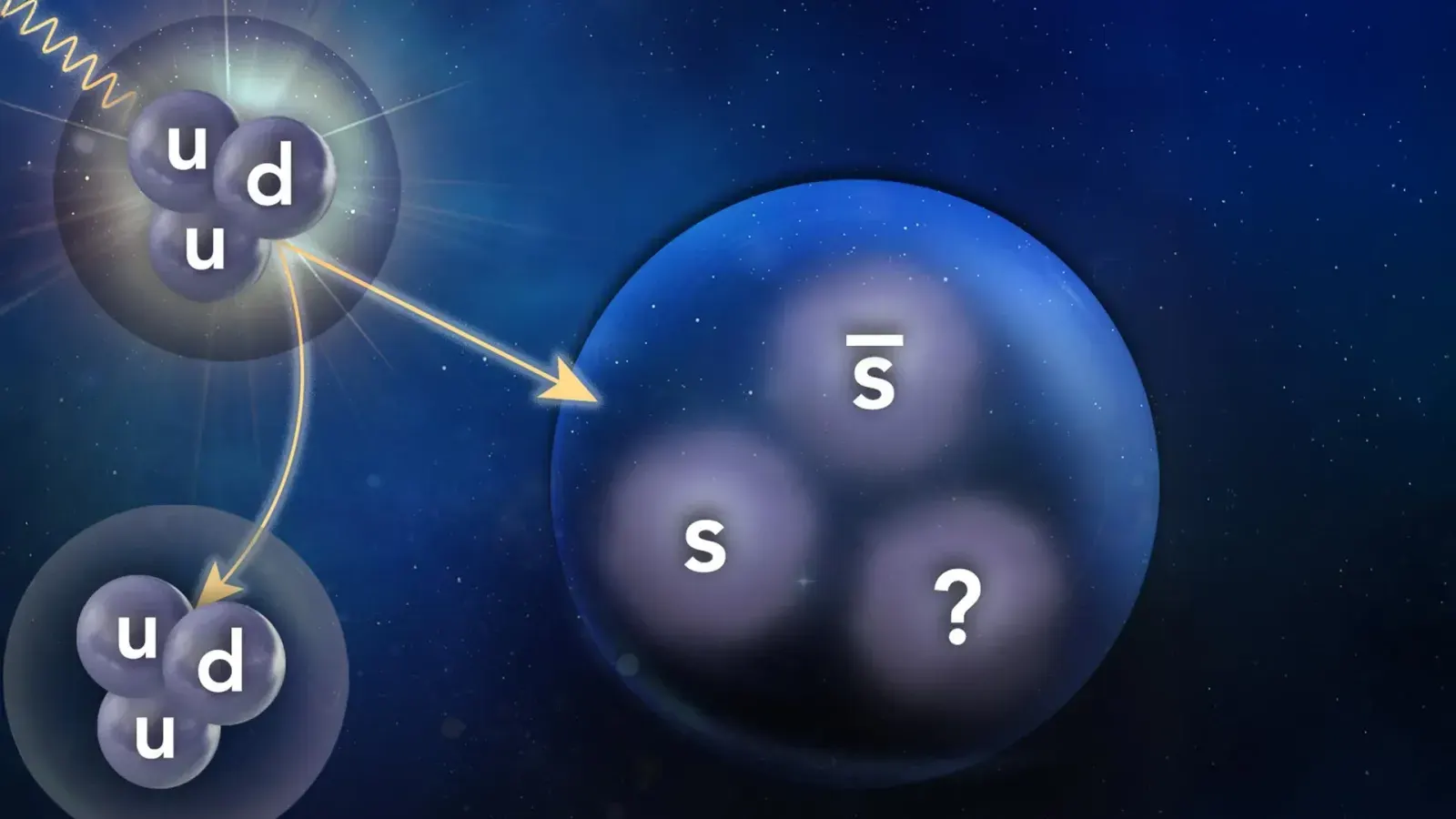
Researchers at the Thomas Jefferson National Accelerator Facility in the United States have identified evidence for two unexpected subatomic structures related to XYZ states. The findings were officially made by the Gluonic Excitations Collaboration, known as GlueX, operating within Experimental Hall D at Jefferson Lab. Following the identification, the research outcomes were published in the scientific publication Physical Review Letters, marking a notable development in experimental subatomic physics.
Malte Albrecht described the unexpected nature of the discovery during their investigation, explaining the initial research goals of the team. "We went searching for a confirmed XYZ candidate with a photon beam but instead found two other structures," Malte Albrecht stated. Elaborating further on the significance of the findings for the scientific community, Malte Albrecht added, "It's new information." Prior to this research, a related state known as Y(2175) was previously created by electron-positron annihilation across multiple major international experiments, including BaBar, BES at the Beijing Spectrometer, and Belle.
The broader context of particle physics research was highlighted by Frank Nerling of the GSI Helmholtz Centre for Heavy Ion Research and Goethe University Frankfurt, who commented on the shifting landscape of subatomic discovery. "First, a zoo of hadrons was discovered. Now, we're facing a zoo of so-called exotic states," Frank Nerling observed regarding the growing complexity of particle classification. This sentiment was further supported by Klaus Goetzen, who emphasized the experimental hurdles involved in confirming these elusive phenomena across the global physics community.
Addressing the difficulties of international verification, Klaus Goetzen pointed out the coordination required between independent laboratories. "The challenge is that you have many measurements around the world in very different experiments that have to find consensus about what they are seeing," Klaus Goetzen explained. Klaus Goetzen also noted the intricate nature of particle mass differentiation, stating, "It's more complicated than it sounds, because there are states that are close by in mass and might or might not be the same thing." These measurements involve specific energy scales, notably including data points around 2.16 billion electron volts, or 2.16 GeV.
To better understand the underlying mechanisms of these newly identified structures, researchers are looking closely at gluonic contributions within mesons. Justin Stevens from William & Mary elaborated on the theoretical implications of these excited states during the analysis. "Excited gluonic fields are what could be in these mesons where you have more than just the quark-antiquark pair," Justin Stevens stated. Expanding on the ongoing objectives of the research team, Justin Stevens concluded, "That's one of the investigations, to try to understand whether there is a gluonic contribution to the structure we see." The research continues to involve institutions such as the U.S. Department of Energy and the SLAC National Accelerator Laboratory as scientists strive for global consensus.