

CPD Dialogue Focuses on RMG Sector Carbon Reduction and Energy Saving
A recent dialogue hosted by the Centre for Policy Dialogue in Dhaka highlighted findings from a comprehensive survey of 350 garment factories regarding renewable energy adoption. Experts discussed significant potential for cutting industrial carbon emissions and energy consumption through modern technologies.
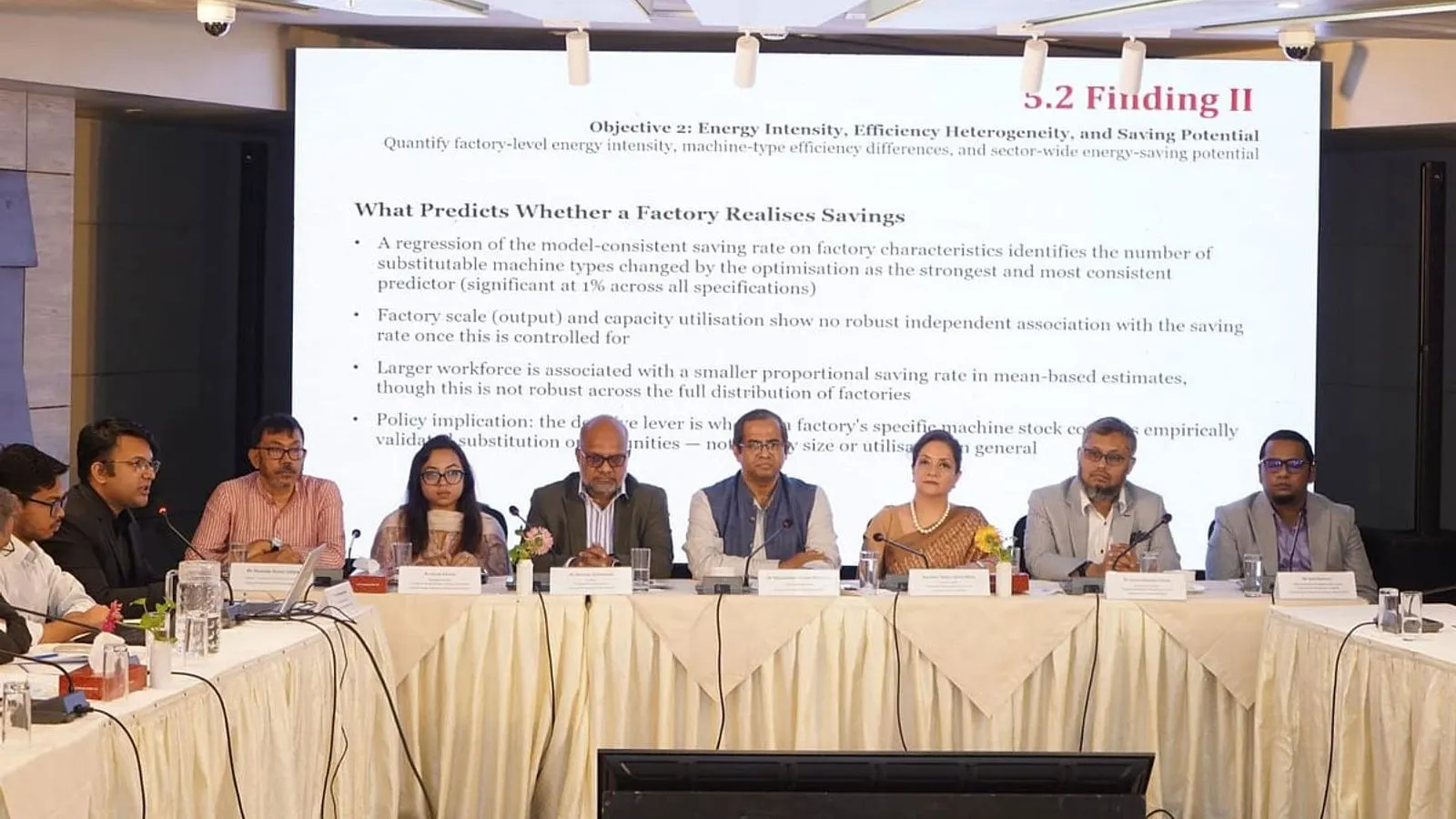
The Centre for Policy Dialogue (CPD) organized a high-level dialogue focusing on reducing industrial carbon emissions and promoting energy-saving initiatives within the country's Ready-Made Garment (RMG) sector. The event took place on Sunday at the Brac Centre Inn located in Mohakhali, Dhaka.
The discussion brought together prominent figures from various organizations, including Khondaker Golam Moazzem representing the CPD, Vidya Amrit Khan, Fazle Shamim Ehsan, Mostafa Al Mahmud, and Sami Mohammad. Representatives were also present from key industry bodies such as the Bangladesh Garment Manufacturers and Exporters Association (BGMEA), the Bangladesh Knitwear Manufacturers and Exporters Association (BKMEA), and the Bangladesh Sustainable and Renewable Energy Association (BSREA).
A core focus of the dialogue was a specialized survey conducted toward the end of last year covering 350 ready-made garment factories concerning renewable energy utilization. According to the findings presented, implementing targeted efficiency measures could yield up to 4 percent in savings, while overall energy consumption could see a reduction ranging from 10 to 17 percent across the surveyed facilities.
Further detailed data from the survey indicated that cumulative electricity savings could exceed 25,000 megawatt-hours. The research also highlighted that implementing these green technologies would require a total investment of 13,209 crore Bangladeshi Taka. Specifically, capital expenditure would stand at 6,604 crore Taka for 50 percent of the factories, scaling up to the full 13,209 crore Taka if 100 percent implementation is achieved across the board.
Regarding departmental energy distribution, the survey noted that 85 percent of energy use is concentrated in the sewing section alone. While this department currently utilizes about 3 percent of the electricity, adopting modern technology creates an opportunity to achieve more than 27 percent of total electricity savings from this department alone. Additionally, incorporating 30 percent solar power could reduce monthly fuel costs by up to 15.7 percent, while concurrently lowering operational risks by at least 4 percent.
However, the financial distribution model for these upgrades presents stark disparities across factory sizes. The data reveals that 71 percent of the total required financing would be necessary for the largest 25 percent of factories. In sharp contrast, a mere 0.3 percent of the total funding is allocated for the smallest category of factories, pointing to critical financial accessibility challenges for smaller enterprises aiming to transition toward sustainable practices.