Dhaka Metrorail Passenger Numbers Surge Amid Financial Loan Challenges
Dhaka's metrorail system has carried over 31.35 million passengers, bringing strong daily ridership alongside significant loan repayment obligations for the operator. Authorities are planning operational expansions as passenger numbers consistently cross hundreds of thousands daily.
The mass transit system in Dhaka has achieved a significant milestone, with more than 31.35 million passengers utilizing the service since its initial launch. According to data provided by the Dhaka Mass Transit Company Limited (DMTCL), the landmark figures reflect the growing reliance on the urban rail network as a vital commuting option for city residents navigating heavy traffic congestion.
Operational phases of the network rolled out progressively, beginning on December 28, 2022, with the opening of the Uttara to Agargaon section. This was followed on November 4, 2023, by the extension connecting Agargaon to Motijheel. Further infrastructural expansion is currently underway from the Motijheel station toward Kamalapur, with authorities scheduling trial runs for this newly extended route in the coming January.
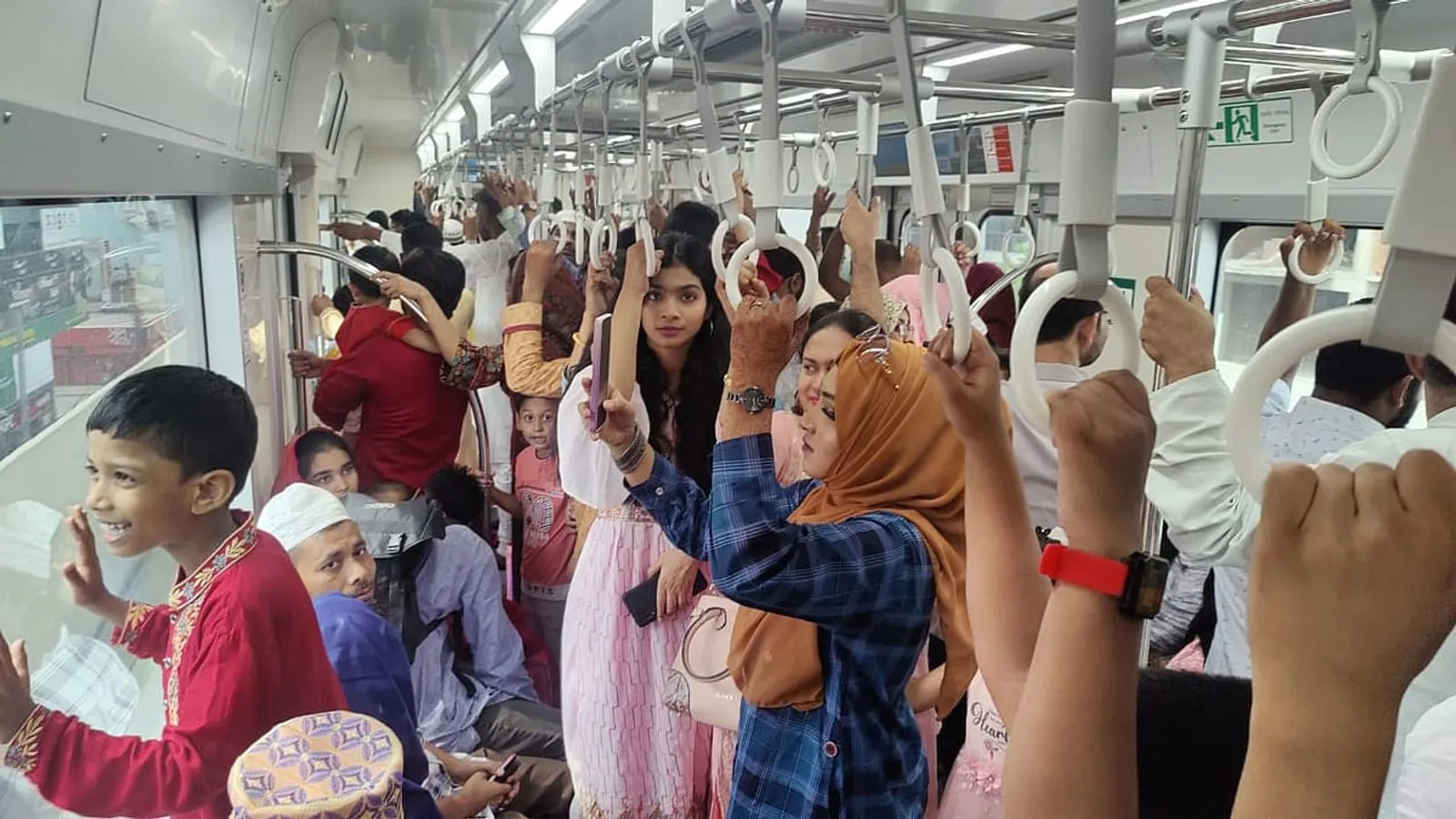
Passenger statistics demonstrate high daily utilization across the transit network. Average daily passenger counts regularly exceed 450,000, with specific dates recording near-peak numbers. On September 10, daily ridership approached five million individuals. Additional high-volume days included September 13 with 480,620 passengers, August 20 with 478,280 passengers, September 14 with 476,815 passengers, and May 21 with 474,635 passengers. At the Motijheel station specifically, an average of 51,542 passengers enter daily while 51,036 passengers exit.
Individual experiences highlight both the convenience and the congestion of the system. Kamal হোসেন, a commuter, noted that he boards the metrorail every morning at 8 a.m. Because he uses the starting station, he secures a seat and comfortably reaches the Dhaka University station within half an hour to arrive at his office, returning home just as easily in the afternoon. However, he observed that passengers boarding from intermediate stations often travel in cramped conditions.
Financial projections and obligations remain a central focus for the management of the rapid transit network. Projections indicate that ticket sales could generate approximately 500 crore Baka annually, alongside estimations that daily passenger numbers could eventually reach 677,000. However, the total construction cost of the project stands at 33,472 crore Taka. This includes a substantial loan of 19,718 crore Taka secured from JICA under the MRT-6 project, requiring the operator to pay more than 3,700 crore Taka in loan installments over a five-year period stretching until the 2030-31 fiscal year, averaging roughly 740 crore Taka annually.
To address both growing demand and financial sustainability, administrative and expert measures are underway. মো. নজরুল ইসলাম stated that sufficient manpower has been secured and that metrorail operations will be gradually extended into the nighttime hours, alongside reductions in the waiting intervals between successive trains. Furthermore, Shamsul Hoque, a transport expert associated with BUET, emphasized that increasing revenue requires expanding both the number of operational trains and their operating hours. Noting that the route is built along Dhaka's most crucial corridor where high passenger demand was anticipated even before construction, he argued that three years after its launch, the system should utilize its full capacity, including operations during nighttime hours and weekly holidays.