
Dhaka Markets Hit by Rising Prices of Essential Commodities
Essential commodity prices have surged across Dhaka's Tejgaon and Karwan Bazar markets, leaving consumers struggling with sudden hikes. Shoppers and traders reported sharp increases in daily necessities, including sugar, flour, and edible oil, yesterday.
A fresh wave of price hikes has hit several key essential commodities across Dhaka markets, causing widespread concern among everyday shoppers and urban consumers. Yesterday, visits to the Tejgaon Samity Bazar and Karwan Bazar in the capital revealed a volatile market scenario characterized by sudden and steep increases in the prices of foundational kitchen staples such as flour, sugar, edible oils, eggs, and broiler chicken, heavily straining household budgets.
During the market inspections, frustrated consumers openly voiced their distress over the escalating costs of basic food items. Rahela বেগম expressed her disbelief at a vendor's stall, questioning why the price had jumped so drastically in such a short span by stating, ' ১৫-২০ দিন আগেও তো ৫৫ টাকায় কিনলাম। কেজিতে এক লাফে ১০ টাকা বাড়াইলেন কেন?' Another disgruntled shopper, Monjur Hossain, echoed similar frustrations regarding the sudden spike in sweetening agents, noting, ' তিন দিন আগে ১১০ টাকা দরে এই দোকান থেকেই চিনি নিয়েছি, এখন কেজিতে ২০ টাকা বেশি নিলেন।'
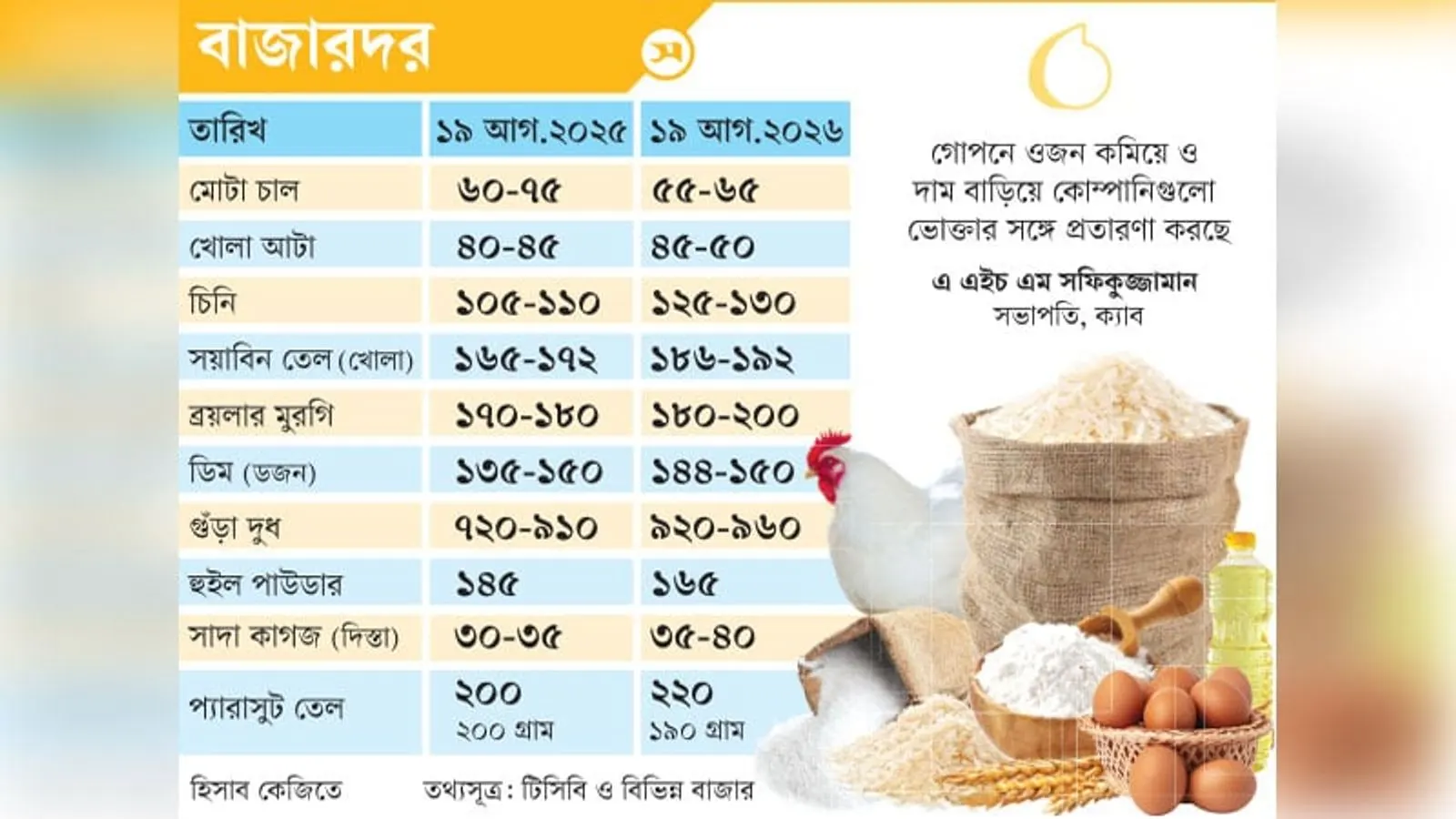
Market data gathered from the locations highlighted specific, burdensome price points for common household items that are now heavily impacting consumers. Standard packaged flour was being retailed at 65 Taka per kilogram, while sugar commanded a steep price of 130 Taka per kilogram. Meanwhile, open soybean oil was changing hands at 186 to 192 Taka per liter, and open palm oil was priced between 166 and 170 Taka per liter. Protein sources were similarly expensive, with broiler chicken selling for 180 to 200 Taka per kilogram, eggs priced at 150 Taka per dozen, powdered items at 960 Taka per kilogram, and open polao rice ranging from 190 to 200 Taka per kilogram.
Retailers at the scene defended their pricing strategies by pointing fingers further up the supply chain, laying the blame squarely on wholesale distributors and corporate practices. Explaining the difficult position of small-scale shop owners, Mo. Rayhan pointed out the immense pressure from suppliers by stating, ' চিনির বস্তায় (৫০ কেজি) এক দিনে ৯০০ থেকে এক হাজার টাকা বাড়িয়েছে ডিলাররা। তাহলে খুচরা ব্যবসায়ীরা কি বাড়ি থেকে এনে লোকসান দেবে?'
Beyond the visible price tags, additional market anomalies were brought to light concerning how goods are being sold to the public. Verified reports from the markets confirmed that open soybean oil and palm oil were actively being sold at rates significantly higher than the official prices previously fixed by the government. Furthermore, unscrupulous business practices have emerged, with certain companies keeping the face value prices of their packaged products unchanged while secretly reducing the net weight of the contents inside.