Bangladesh Bans Hilsa Fishing for 22 Days as Catch Plummets
Bangladesh has announced a 22-day ban on catching Hilsa fish from October 8 to 29 following a sharp 30 to 40 percent decline in yields during the July-August period of the current 2026-27 fiscal year. The decision was finalized during a meeting of the National Task Force Committee on Hilsa Resource Development to protect spawning fish and ensure sustainable production.
Bangladesh is facing a severe decline in its national Hilsa fish harvest, prompting immediate government action and a strict upcoming nationwide fishing ban. According to official reports, Hilsa harvesting across the country dropped significantly by 30 to 40 percent during the months of July and August in the current 2026-27 financial year, when compared directly with the exact same corresponding period from the previous year. This alarming downturn has heavily impacted the fisheries sector, drawing profound concern from researchers, government officials, and national task force members alike.
To combat this mounting crisis, a crucial decision was officially adopted during a meeting held by the National Task Force Committee on Hilsa Resource Development. Authorities have formally declared a 22-day nationwide ban on catching Hilsa, which will officially remain in effect starting from the upcoming 8th of October and continuing through the 29th of October. During this strict enforcement period, all forms of Hilsa fishing will be completely prohibited across the country to allow the fish a proper window for reproduction.
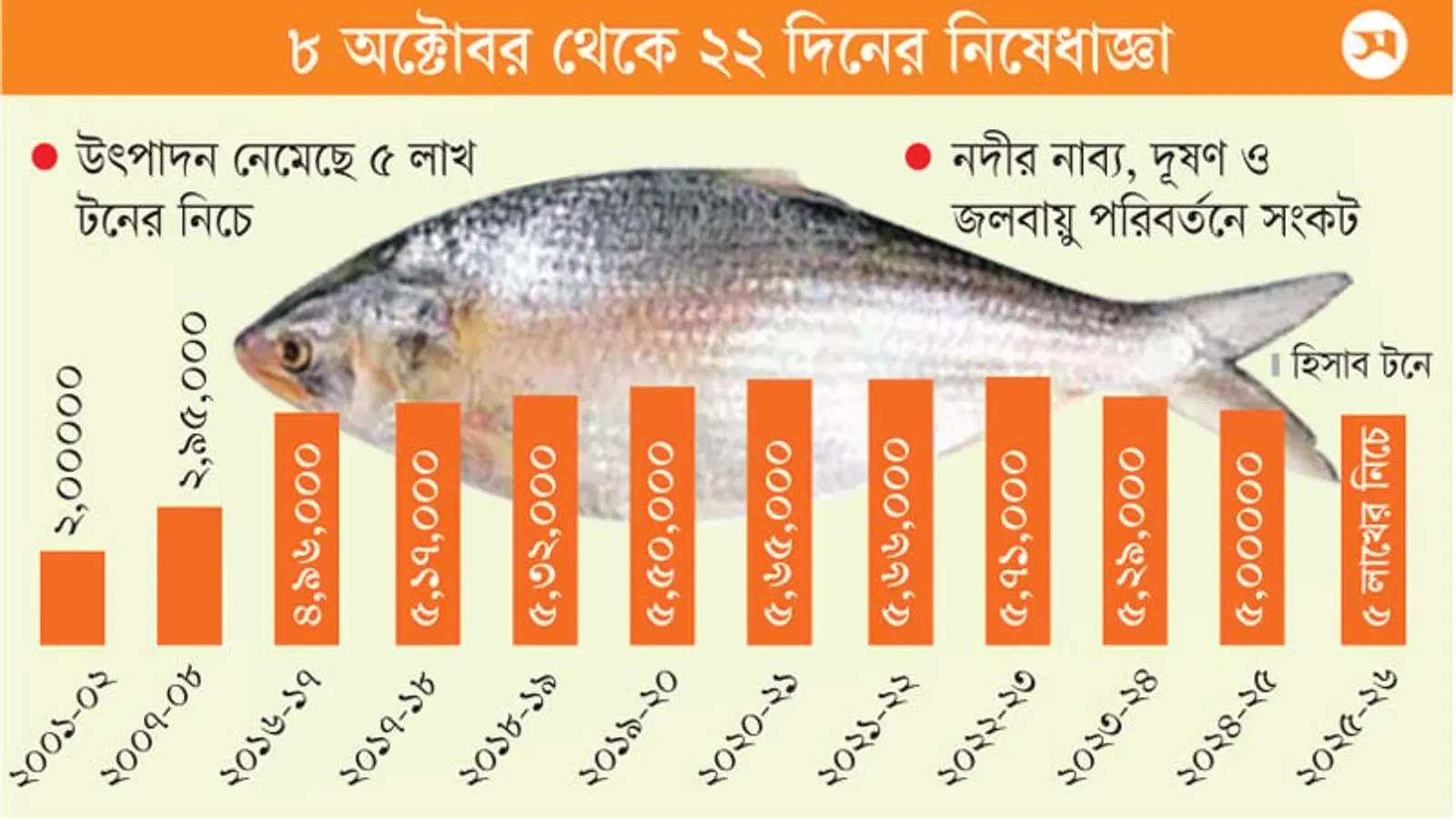
Historical production data compiled by the authorities illustrates a dramatic trajectory over the past two decades. Back during the 2001-02 financial year, total domestic Hilsa production stood at approximately two lakh tonnes, before gradually rising to two lakh and ninety-five thousand tonnes by the 2007-08 financial year. Production scaled up substantially in subsequent years, reaching four lakh and ninety-six thousand tonnes in 2016-17, five lakh and seventeen thousand tonnes in 2017-18, five lakh and thirty-two thousand tonnes in 2018-19, five lakh and fifty thousand tonnes in 2019-20, five lakh and sixty-five thousand tonnes in 2020-21, and peaking at five lakh and sixty-six thousand tonnes during the 2021-22 financial year. However, the upward trend reversed sharply in recent years; production hit a record high of five lakh and seventy-one thousand tonnes in 2022-23, only to drop down to five lakh and twenty-nine thousand tonnes in 2023-24, decline further to approximately five lakh tonnes in 2024-25, and ultimately plummet below the five lakh tonne threshold during the 2025-26 fiscal year.
Experts in the field have voiced deep alarm over these unprecedented downward statistics. Anisur Rahman, who has spent 33 years conducting dedicated research on Hilsa, stated that he has never felt so deeply worried about the current situation regarding falling production volumes. He noted that alongside natural environmental factors, the primary drivers behind this diminishing yield are excessive fishing activities and the widespread capture of juvenile Hilsa fish.
Addressing the pressing need for strict regulatory enforcement, Mohammad Amin Ur Rashid emphasized that no leniency will be tolerated whatsoever when it comes to safeguarding mother Hilsa to guarantee sustainable production levels. He highlighted that monitoring operations and targeted enforcement drives will be intensely strengthened across all primary breeding zones, specifically mentioning regions such as Barishal, Chandpur, and Bhola. Furthermore, he stressed that surveillance must be actively expanded across local ice factories, wholesale commission markets, and general retail marketplaces to completely halt the commercialization of illegally harvested Hilsa, while also advising specific operations to clear out illegal fishing nets within prime breeding grounds like the Chandpur confluence.
Echoing these administrative concerns, Sultan Salauddin Tuku pointed out that the underlying causes responsible for the steep drop in Hilsa output must be thoroughly investigated through comprehensive research studies. He explicitly described the situation as deeply alarming because the severe domestic production shortfall has forced the country to resort to importing Hilsa instead. Consequently, he confirmed that a fully coordinated master action plan will be formulated and implemented to successfully restore and boost overall production, while authorities have concurrently decided to distribute Vulnerable Group Feeding (VGF) food assistance supplies to support the affected fishermen who must abstain from fishing throughout the duration of the official ban.