

Bangladesh Faces Critical Internet Bandwidth Crisis Amid Cable Delays
Bangladesh is grappling with a severe international bandwidth capacity crisis and mounting delays in vital new submarine cable projects. Rapidly surging data demands clash with bureaucratic hurdles and geopolitical complexities, threatening the nation's digital infrastructure.
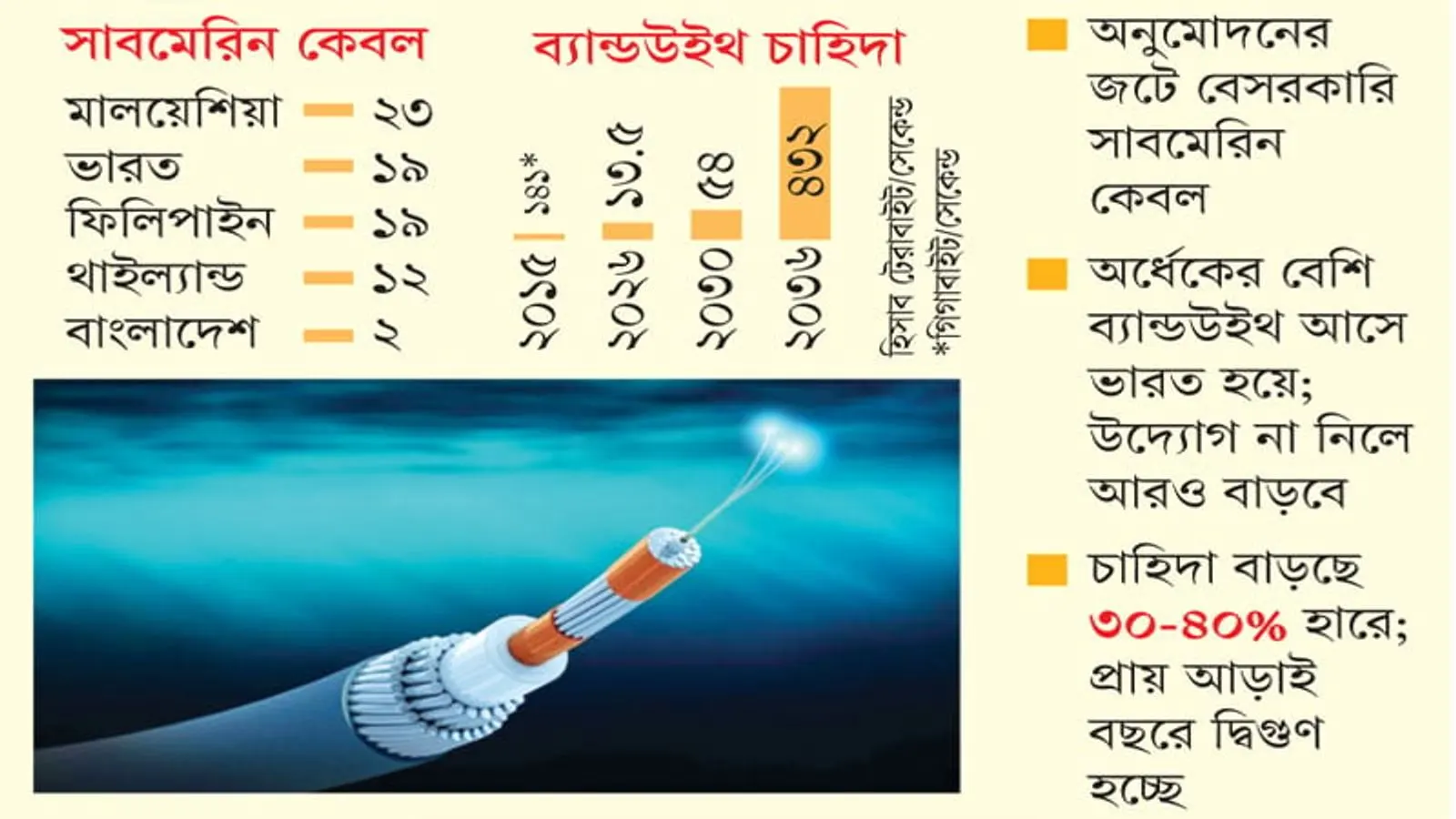
Bangladesh is currently facing a critical international bandwidth capacity crisis alongside significant delays in the implementation of new submarine cable projects. According to the data released on 08 September 2026, the nation's digital infrastructure is struggling to keep pace with an exponential surge in data consumption that far outstrips current supply capabilities, creating a major bottleneck for the telecommunications sector.
Official statistics illustrate the staggering growth of internet usage across the country over the past decade. In 2015, the total national demand for bandwidth stood at a modest 141 gigabits per second (Gbps). By 2026, this requirement has skyrocketed to approximately 13.5 terabits per second (Tbps), representing an increase of more than 95 times over the span of just 11 years. Projections indicate that the trajectory will steepen further, with demand expected to reach 27 Tbps in 2028 and 54 Tbps by 2030. Long-term forecasts suggest requirements could surge to 108 Tbps in 2032, 216 Tbps in 2034, and as high as 305 Tbps by 2035.
Presently, the total international traffic stands at approximately 12.1 Tbps, while the country's international connectivity relies primarily on two core submarine cables: SEA-ME-WE-4 and SEA-ME-WE-5. The individual capacities of the SEA-ME-WE-4 and SEA-ME-WE-5 cables are 4.6 Tbps and 2.5 Tbps respectively, with the lit-up capacity of SEA-ME-WE-5 resting at approximately 2.2 Tbps, leaving about 712 Gbps of unused capacity. Amid these constraints, over half of Bangladesh's total bandwidth currently arrives via India, which maintains 19 international submarine connections compared to 23 in Malaysia and 12 in Thailand.
To address the burgeoning shortfall, private sector initiatives have been attempted, notably through the BPCS Consortium. However, the private sector BPCS Consortium submarine cable project remains severely stalled due to a combination of bureaucratic red tape and geopolitical complexities. The financial scope of this stalled venture is substantial, involving a total project cost of approximately 2.7 billion taka. To cover foreign expenses for laying the line, a requirement of 42 million dollars was established, out of which 32 million dollars has already been disbursed.
The multifaceted challenges involve numerous domestic entities and stakeholders across the administrative apparatus, including Mohammad Aminul Hakim, Mashiour Rahman, BTRC, Summit Communications, Cidnter Communications, Metacore Subcom, the BPCS Consortium, the Ministry of Foreign Affairs, the Ministry of Home Affairs, NSI, the Posts and Telecommunications Division, Bangladesh Submarine Cables PLC, HMN Tech, and Nokia. As demand continues to outpace the slow deployment of new infrastructure, stakeholders warn that urgent resolution of the administrative and geopolitical bottlenecks is essential to avert a wider digital standstill.